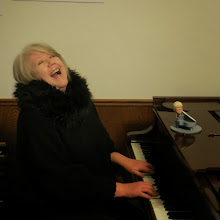
I did it! I performed Chopin's Butterfly Etude for my students, but I'm not going to post the recording. I had too many note mistakes in the middle section - where I lost focus. That aside several of my goals for this project were met.
1. I played the piece everyday for 10 minutes for a month (well really just 28 days, since the month I started the project was February)
2. I had a disciplined approach to learning the piece which I followed.
3. While performing the piece I did not rush, played musically and nailed the ending.
I really love this piece and will continue to work on it...I think for 10 minutes a day as part of my technical practice.
Showing posts with label Chopin Etudes. Show all posts
Showing posts with label Chopin Etudes. Show all posts
Monday, March 2, 2009


Sunday, March 1, 2009
Peformance Today
Today is the Day! I'm going to play Chopin's Butterfly Etude after practicing for 10 minutes a day for the past month. I must confess that over the last few days...I've played the work for more than 10 minutes....nerves...

(STAR Branch...Handmade by Bee)...Today I will be a Star!
Some thoughts regarding the last few weeks of practicing. I haven't written about my process so much because I've been PRACTICING!
1. I noticed again that sleep does help with learning. (See my post on October 10, 2007 on Tempo. I note the science behind learning in your sleep).) In the Butterfly Etude there is a passage where the left hand chords only changed a little and when pared with the right hand melodic line created a great deal of dissonance. This passage gave me a great deal of difficulty. I paused every time I made it to that phrase. Tamara Loring told me to physically feel the the chords and the dissonances. That helped, but didn't solve the problem. So one morning before I was completely awake and was lucid dreaming, I saw that the pattern of the white and black keys in the chords were mirror images of each other. I saw clearly in my mind the chords:
First chord:
(white, white, black)
Second chord
(black, white, black),
Third chord
(black, white, black) and the
Final chord in the series
(black, white, white)
At my practice that day I played that section with great ease. Problem solved!
2. Also, the maxim that several teachers have tired to teach me EVERYTHING YOU NEED IS THE SCORE (paraphrased, but I hope you get the meaning) is true. The same passage above had one more element that I needed to never miss it (at least in practice) and that was to observe the accent marks in the right hand...by emphasising the dissonance as Chopin indicates, the ear and hand agree and mistakes are not possible.
3. I did enjoy listening to so many interpretations of the work. I had lots of artistic material to draw my own conclusions. My version at this date is lyrical, not too fast, with an emphasis on the horizontal melody line and dynamics.
So now I must play.

(STAR Branch...Handmade by Bee)...Today I will be a Star!
Some thoughts regarding the last few weeks of practicing. I haven't written about my process so much because I've been PRACTICING!
1. I noticed again that sleep does help with learning. (See my post on October 10, 2007 on Tempo. I note the science behind learning in your sleep).) In the Butterfly Etude there is a passage where the left hand chords only changed a little and when pared with the right hand melodic line created a great deal of dissonance. This passage gave me a great deal of difficulty. I paused every time I made it to that phrase. Tamara Loring told me to physically feel the the chords and the dissonances. That helped, but didn't solve the problem. So one morning before I was completely awake and was lucid dreaming, I saw that the pattern of the white and black keys in the chords were mirror images of each other. I saw clearly in my mind the chords:
First chord:
(white, white, black)
Second chord
(black, white, black),
Third chord
(black, white, black) and the
Final chord in the series
(black, white, white)
At my practice that day I played that section with great ease. Problem solved!
2. Also, the maxim that several teachers have tired to teach me EVERYTHING YOU NEED IS THE SCORE (paraphrased, but I hope you get the meaning) is true. The same passage above had one more element that I needed to never miss it (at least in practice) and that was to observe the accent marks in the right hand...by emphasising the dissonance as Chopin indicates, the ear and hand agree and mistakes are not possible.
3. I did enjoy listening to so many interpretations of the work. I had lots of artistic material to draw my own conclusions. My version at this date is lyrical, not too fast, with an emphasis on the horizontal melody line and dynamics.
So now I must play.
Tuesday, February 10, 2009
A Week's Progress
After one week of 10 minutes a day on the Chopin Etude (Opus 25, No. 9) I've
1. learned all of the notes,
2. can play the left hand at quarter note equals 90,
3. have memorized 12 bars of the music, and
4. can play hands together at half tempo / quarter note equals 55.
Areas of concern...
1. the middle section is not as good as the beginning and end sections,
2. I keep missing notes in the left hand at the end of the piece / I'm having trouble playing the 5ths and 6ths when my arm has to cross in front of my body and the octave jumps from "G Flat" to "D Flat" that descend at the end...I keep missing the notes (I want to put the third of the chord "B Flat" into the octave progression), and
3. I'm already in a panic about the tempo!
This week I plan to
1. start in the the middle of the work,
2. continue working on the left hand alone,
3. continue memorizing one measure at a time,
4. review, review, review what I've learned so far, and
5. only play at half tempo or slower, but move into position quickly
I'm going to also try some of the techniques I was exposed to at the Portland International Festival from my participation in the workshops lead by pianist Frederic Chiu . He suggests spending a great deal of time with the score and thinking about the piece away from the piano. I'm very interested in his program "Deeper Piano Studies" and I'd like to attend one of his workshops. I'm going to increase my study to 20 minutes this week (10 at the piano / 10 away from the piano) to see if that makes a difference. I'm also listening to as many performers of the piece as possible.
1. learned all of the notes,
2. can play the left hand at quarter note equals 90,
3. have memorized 12 bars of the music, and
4. can play hands together at half tempo / quarter note equals 55.
Areas of concern...
1. the middle section is not as good as the beginning and end sections,
2. I keep missing notes in the left hand at the end of the piece / I'm having trouble playing the 5ths and 6ths when my arm has to cross in front of my body and the octave jumps from "G Flat" to "D Flat" that descend at the end...I keep missing the notes (I want to put the third of the chord "B Flat" into the octave progression), and
3. I'm already in a panic about the tempo!
This week I plan to
1. start in the the middle of the work,
2. continue working on the left hand alone,
3. continue memorizing one measure at a time,
4. review, review, review what I've learned so far, and
5. only play at half tempo or slower, but move into position quickly
I'm going to also try some of the techniques I was exposed to at the Portland International Festival from my participation in the workshops lead by pianist Frederic Chiu . He suggests spending a great deal of time with the score and thinking about the piece away from the piano. I'm very interested in his program "Deeper Piano Studies" and I'd like to attend one of his workshops. I'm going to increase my study to 20 minutes this week (10 at the piano / 10 away from the piano) to see if that makes a difference. I'm also listening to as many performers of the piece as possible.
Thursday, February 5, 2009
Oh No!
Continuing on the ten minutes of practice a day Chopin Experiment I've hit upon a snag...
Getting the left hand up to tempo wasn't as big of a chore as I thought it was going to be (years of playing stride bass parts finally pays off!), but the right hand octaves up to tempo will present some challenges. What was I thinking? I hope my Butterflies won't be arthritic (ie: slow) on March 1!
Here are some links to YouTube performances that inspire me...
Alicia de Larrocha
http://www.youtube.com/watch?v=sJ4P8OpVL3E
Maurizio Pollini
http://www.youtube.com/watch?v=i27_BGnB1M0
Dr. Walden Hughes
http://www.youtube.com/watch?v=SHHHv83cwXQ
Getting the left hand up to tempo wasn't as big of a chore as I thought it was going to be (years of playing stride bass parts finally pays off!), but the right hand octaves up to tempo will present some challenges. What was I thinking? I hope my Butterflies won't be arthritic (ie: slow) on March 1!
Here are some links to YouTube performances that inspire me...
Alicia de Larrocha
http://www.youtube.com/watch?v=sJ4P8OpVL3E
Maurizio Pollini
http://www.youtube.com/watch?v=i27_BGnB1M0
Dr. Walden Hughes
http://www.youtube.com/watch?v=SHHHv83cwXQ
Wednesday, February 4, 2009
10 minutes a day
I'm always telling my students that just 10 minutes a day of practice will make all of the difference in their playing. My students do not really believe me, so I decided to prove my theory by learning a Chopin Etude in just 10 minutes a day (so I'm not just saying "do as I say, not as I do", but "do as I say and as I do too"). I will perform the piece for my students on their recital on March 1, 2009.
I began this experiment on February 2, and I've chosen to study Chopin's Etude "The Butterfly" Opus 25, No. 9.
First I slowly read through the piece hands together. Then I began to formulate a practice plan.
For me the left hand part will be more difficult that the right, because of the leaps and there are more notes (!)
1. practice the left hand alone every day
2. bring the left hand up to tempo right away / practice 4 - 8 bars up to tempo
Try not to start at the beginning every day
1. start at the "end" one day, then the "beginning" the next day
2. only work on sections / 4-8 bars a day
Slowly put the hands together
1. I found uncomfortable stretches for my right hand - then because I was slow, I realized that I was not bringing my arm over with my hand
2. Play lightly - sometimes when I'm slow I tend to use too much arm weight / think light butterflies fluttering from note to note
Memorize as I learn
1. I heard about this technique at the Portland Piano Festival last summer (July 2008). It was a tip from pianist Hans Boepple. Learn the first measure and play from memory. When the memory is secure memorize the second measure and then play the first two measures from memory, repeat until the piece is memorized
2. Analyze the harmony / this helps with memory and quick note learning
This is my strategy for this week. By next Monday, all the notes will be learned, the left hand part will be up to tempo, the whole piece will be played hands together at a medium speed, and some parts will be memorized.
I began this experiment on February 2, and I've chosen to study Chopin's Etude "The Butterfly" Opus 25, No. 9.
First I slowly read through the piece hands together. Then I began to formulate a practice plan.
For me the left hand part will be more difficult that the right, because of the leaps and there are more notes (!)
1. practice the left hand alone every day
2. bring the left hand up to tempo right away / practice 4 - 8 bars up to tempo
Try not to start at the beginning every day
1. start at the "end" one day, then the "beginning" the next day
2. only work on sections / 4-8 bars a day
Slowly put the hands together
1. I found uncomfortable stretches for my right hand - then because I was slow, I realized that I was not bringing my arm over with my hand
2. Play lightly - sometimes when I'm slow I tend to use too much arm weight / think light butterflies fluttering from note to note
Memorize as I learn
1. I heard about this technique at the Portland Piano Festival last summer (July 2008). It was a tip from pianist Hans Boepple. Learn the first measure and play from memory. When the memory is secure memorize the second measure and then play the first two measures from memory, repeat until the piece is memorized
2. Analyze the harmony / this helps with memory and quick note learning
This is my strategy for this week. By next Monday, all the notes will be learned, the left hand part will be up to tempo, the whole piece will be played hands together at a medium speed, and some parts will be memorized.
Subscribe to:
Posts (Atom)


 Posts
Posts